After 20 Years Researching Inside America's Top Medical Universities, Dr. Andrew Ross Finally Reveals Why Your Ears Won't Stop Ringing — And Why Every Treatment You've Tried Was Never Going to Work
The answer has nothing to do with your ears. It starts with a fragile signal pathway inside your brain that no doctor has ever checked — and what he found after his own mother nearly lost everything — may change the way this condition is treated forever.
Margaret, 71 — San Francisco
No product pitch. No subscription. Just the truth about why the ringing won't stop.
You Haven't Failed. The Treatments Were Never Built to Actually Work.
You did what anyone would do. You went to the doctor. You tried the drops, the supplements, the sound machines, maybe even the specialist visits that cost hundreds out of pocket. Some days the ringing felt a little quieter. Then it came back — louder, more relentless, as if it had learned to ignore everything you threw at it.
That's not a fringe claim. It's what a study commissioned by the European Commission for Health found after reviewing decades of pharmaceutical data. The treatments aren't failing because tinnitus is untreatable. They're failing because they are targeting the wrong place entirely. Every drop, every pill, every hearing aid is built around the assumption that tinnitus is an ear problem. Current research says otherwise.
Think about what you've been through. You've possibly stopped going to certain social situations because following conversations became exhausting. You've lain awake at night negotiating with a sound that doesn't care about logic. You've felt the creeping worry that this is just how the rest of your life sounds now. That fear is not irrational — and it is not permanent.
What no one told you — what most doctors genuinely don't know yet — is that researchers studying people who are completely deaf have uncovered something that changes everything about how tinnitus is understood. People with zero hearing still suffer from the ringing. That single finding dismantled a century of conventional treatment logic. And it points directly to where the real problem lives.
The answer isn't what any specialist has told you.
Scientists Now Believe Tinnitus Starts in the Brain — Not the Ear
A landmark study published in Nature Neuroscience identified something that had been overlooked by mainstream medicine for generations. Inside the ear, finer than a human hair, there is a microscopic nerve fiber that carries sound signals from the inner ear directly to the brain. When this connection is damaged or misfiring, the brain doesn't receive clean signals — it receives noise.
Researchers at major institutions including the University of Iowa and the University of Auckland have been raising the alarm about this discovery. The ringing, buzzing, hissing, and whooshing that tinnitus sufferers hear isn't coming from the ear canal. It is the brain reacting to a broken signal line — a faulty connection that conventional treatments have never once targeted.
What the Research Confirms
The True Culprit Is a Damaged Connection Between Your Ear and Your Brain
This overlooked connection — what researchers call the neural junction — is where the real damage occurs. When it deteriorates, the consequences reach far beyond hearing. It affects memory, focus, sleep, and emotional stability. The longer it goes unaddressed, the wider that damage spreads. This is why tinnitus so often comes packaged with brain fog, chronic fatigue, and anxiety. They are not separate problems. They are the same broken circuit expressing itself in different ways.
Studies now show that people who have lived with tinnitus for an extended period face a significantly elevated risk of neurological complications — including memory decline and cognitive deterioration. This is not meant to alarm. It is meant to explain why treating only the sound was never going to be enough, and why so many people who did everything right still ended up with no lasting relief.
Includes findings from Harvard, University of Iowa and University of Auckland.
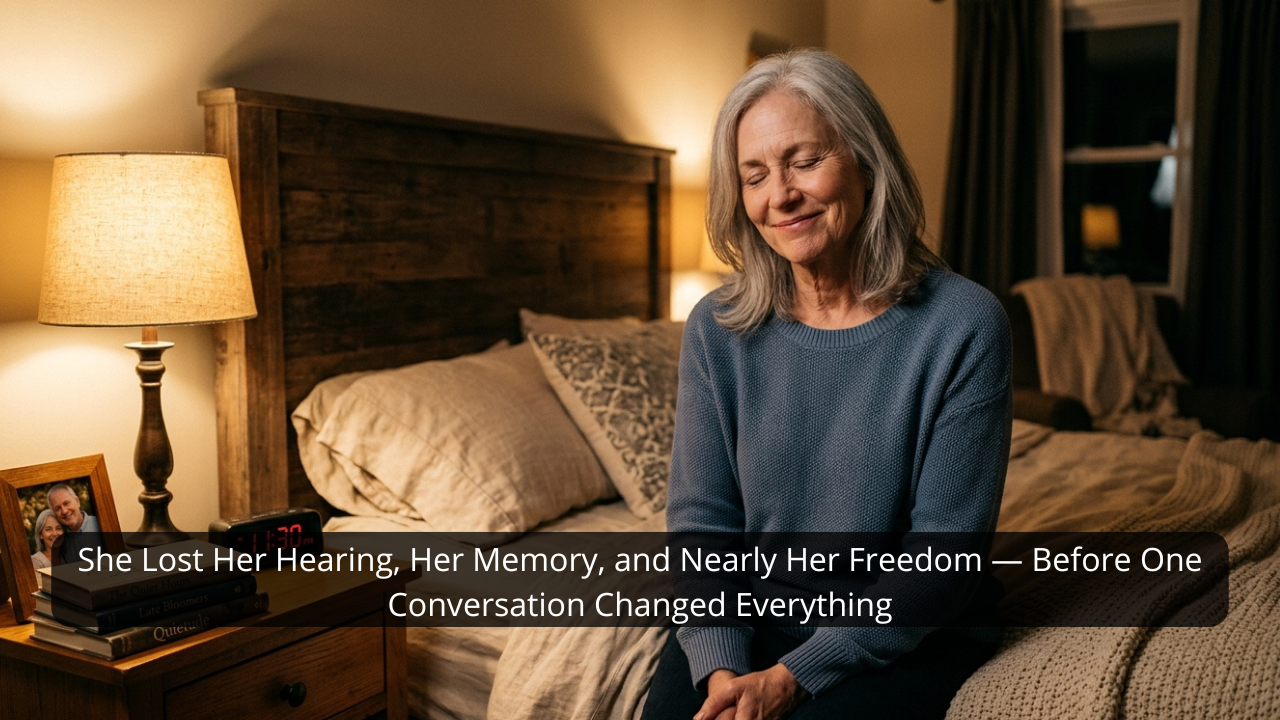
She Lost Her Hearing, Her Memory, and Nearly Her Freedom — Before One Conversation Changed Everything
Margaret had always been the sharp one in the room. The woman who could hear the kettle begin to rattle from the next floor, who remembered every birthday without a calendar, who never once asked anyone to repeat themselves. Then, in her late sixties, a soft ringing started. She barely noticed at first.
Within two years, the ringing had become a roar. She tried Ginkgo tablets from the pharmacy. She bought a sound machine that sat on her nightstand and buzzed uselessly alongside the noise already inside her head. She saw a specialist who recommended hearing aids. She bought them. They helped with the hearing. The ringing didn't care.
The fog came next. She'd open the refrigerator and stand there, completely blank. She stopped accepting social invitations because following group conversations had become exhausting and humiliating. Then came a Wednesday night that her son says he will never forget.
Her son — a researcher who had spent two decades studying the brain — rushed to the station that night and made a decision. He was going to find the real answer, no matter what it took. What he discovered over the following weeks wasn't in any doctor's office or pharmacy aisle. And what happened to Margaret after that...
The full story — and the science behind it — is in the video above.
Is This Happening to You?
Check every symptom you've experienced in the past 30 days. The result may explain more than you expect.
Level 1 — Early Warning
Level 2 — Escalating
Level 3 — Urgent
Why tinnitus treatments keep failing — explained